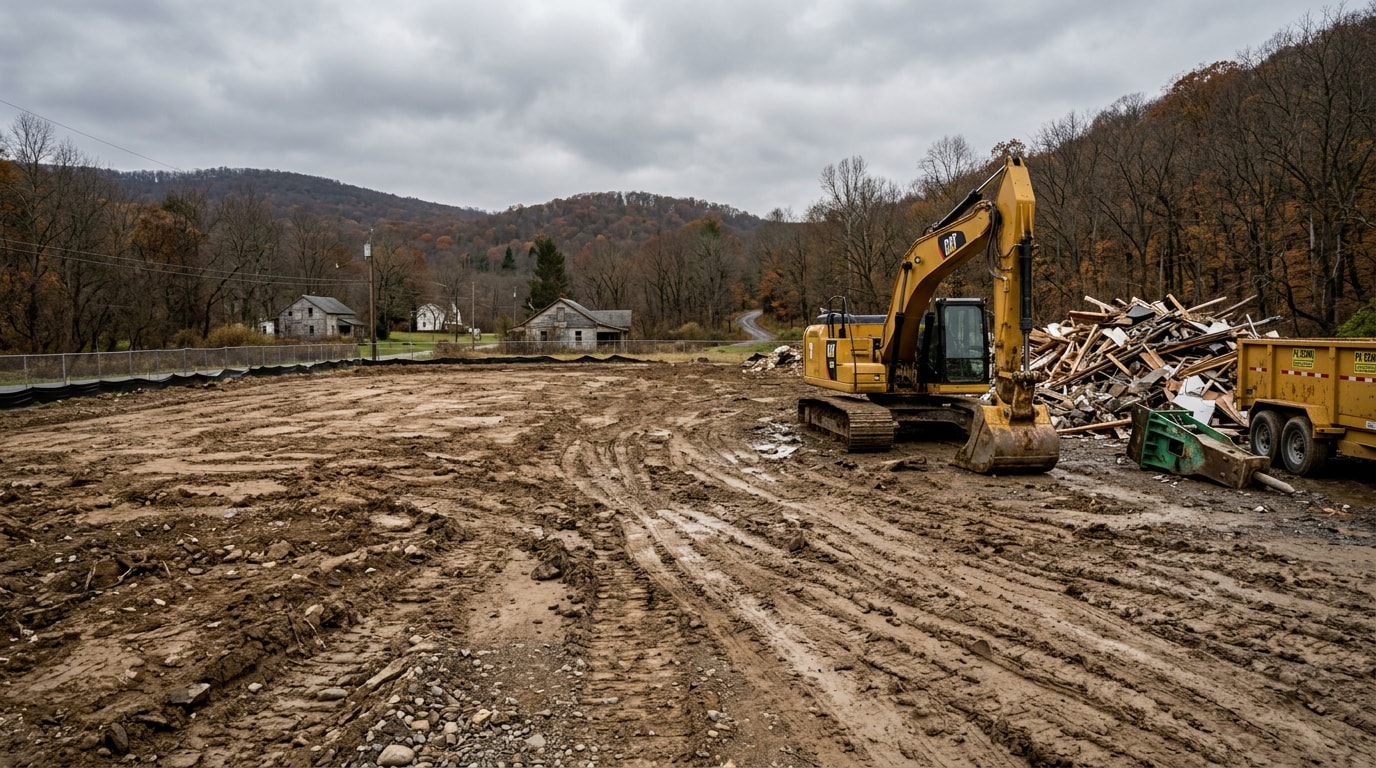
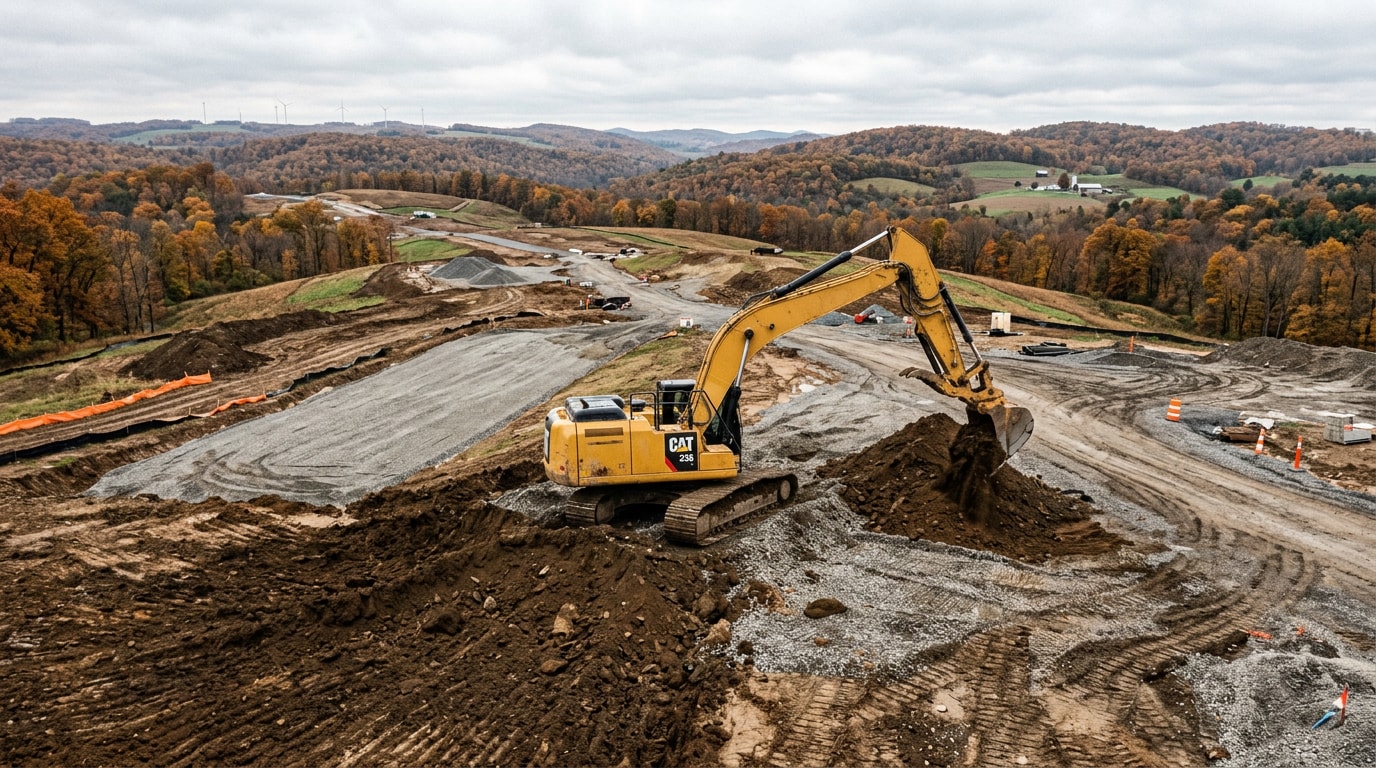
Civil constructors in Washington County, PA do the ground-level work that most building projects can't skip: grading a pad, trenching for utilities, and solving the drainage problems that come with the county's rolling terrain. Here's what that work actually involves, what it costs in 2026, and how to vet a contractor before you sign anything.
What Is a Civil Contractor?
A civil contractor plans and builds the land-based and below-grade systems a project needs before anything goes vertical: cleared and graded ground, compacted subgrade, underground utility lines, and drainage that actually moves water away from a structure instead of toward it. None of that is optional. A foundation can't be poured on unstable soil, and a building can't get an occupancy permit with utilities that were never run.
Most projects start with land clearing to remove trees, stumps, and debris, then move into grading and excavation before utilities and drainage go in. Skipping or rushing any one of those steps tends to show up later as a cracked slab, a flooded basement, or a failed inspection.
Civil Contractor vs. General Contractor: What's the Difference?
A general contractor builds the structure: framing, roofing, interior finishes, and the systems inside the walls. A civil contractor works on the site and below it, doing the work that makes the building possible in the first place. On larger commercial jobs, the two work in sequence, with civil work staged ahead of the general contractor's crews, sometimes overlapping toward the end of a project.
| Factor | Civil Contractor | General Contractor |
|---|---|---|
| Scope | Site work, grading, below-grade construction | Framing, roofing, interior finishes |
| Project phase | Before and during site prep | After the site is ready, through completion |
| Typical deliverables | Graded pads, utilities, drainage, driveways | Finished buildings, interiors |
A homeowner adding a driveway or regrading a yard may only need a civil contractor. A new build or commercial development almost always needs both, on a coordinated schedule.
What Civil Constructors Build in Washington County, PA
The work breaks down into a few categories that show up on nearly every project in this county:
- Site work and excavation – grading, earthwork, and foundation excavation sized to engineering specs. This is the most common type of civil work here, residential or commercial.
- Underground utilities – waterline, gas line, and sewer line installation, plus trench excavation to reach them.
- Drainage systems – storm lines and French drain installation to manage water on sloped or clay-heavy lots.
- Lot and land prep – lot clearing and site preparation ahead of a new build.
- Roads and base work – subgrade compaction, base layers, and curb and gutter, mostly on subdivision and commercial sites.
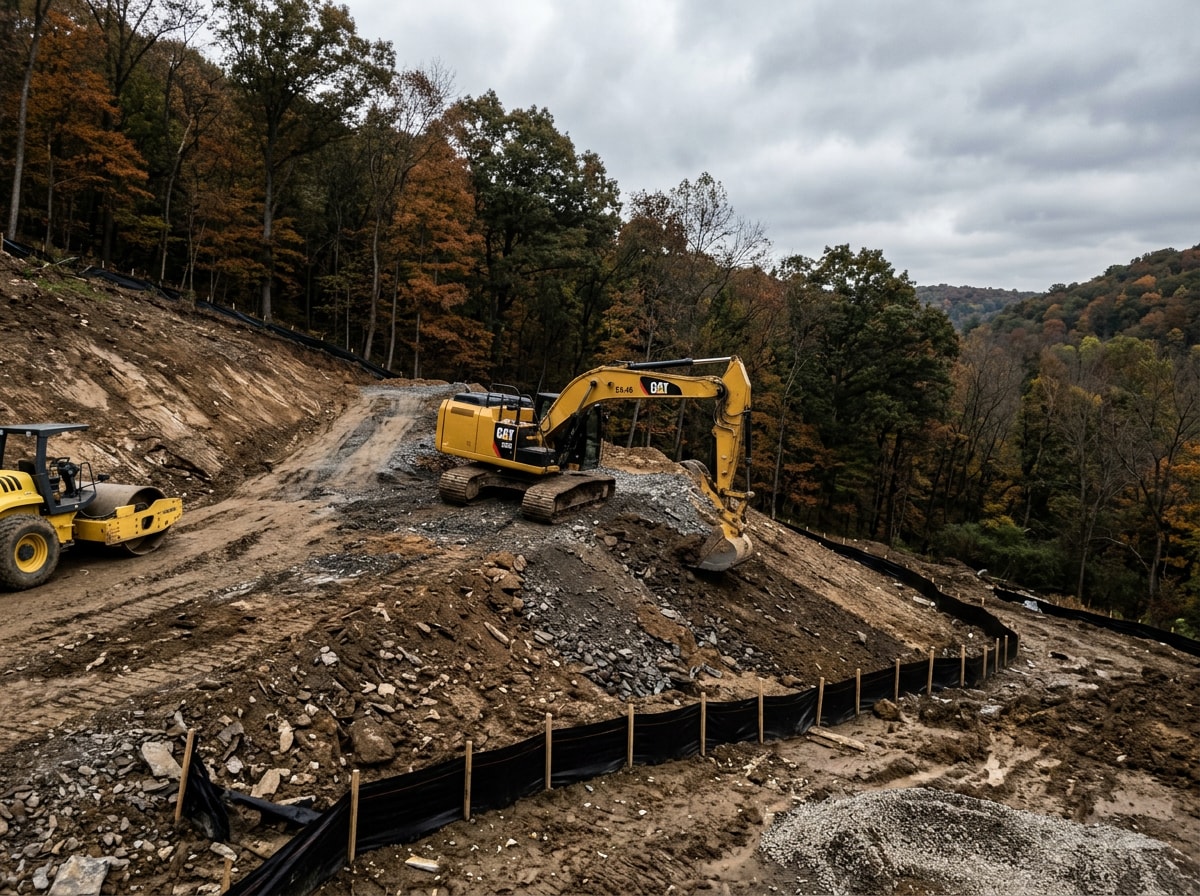
Terrain drives a lot of these decisions locally. Washington County runs from flat, built-out boroughs to hilly townships where shale or sandstone sits close to the surface. On a recent lot-grading job north of the city of Washington, our crew hit rock about two feet down in an area with no prior soil borings, a condition that's common enough in the county's hillier townships that it's worth budgeting for before a shovel ever moves.
Local Terrain and Permitting Notes for Washington County, PA
Washington County's mix of former coal-mining land, agricultural parcels, and growing suburban corridors near Southpointe means site conditions vary block to block, not just township to township. That matters for permitting, too. For larger subdivisions, the Washington County Planning Commission assesses applications using environmental maps covering landslides, wetlands, flooding, mine subsidence, and Natural Heritage Areas , a review step that smaller residential jobs don't trigger but that commercial and multi-lot developments should plan around early.
A contractor working across Washington County, PA should be able to tell you, before digging starts, whether a given township tends to have rockier subgrade, higher water tables, or legacy mine workings underfoot. That's the kind of local knowledge that keeps a schedule from blowing up mid-project. You can see examples of completed grading and utility work in our project gallery.
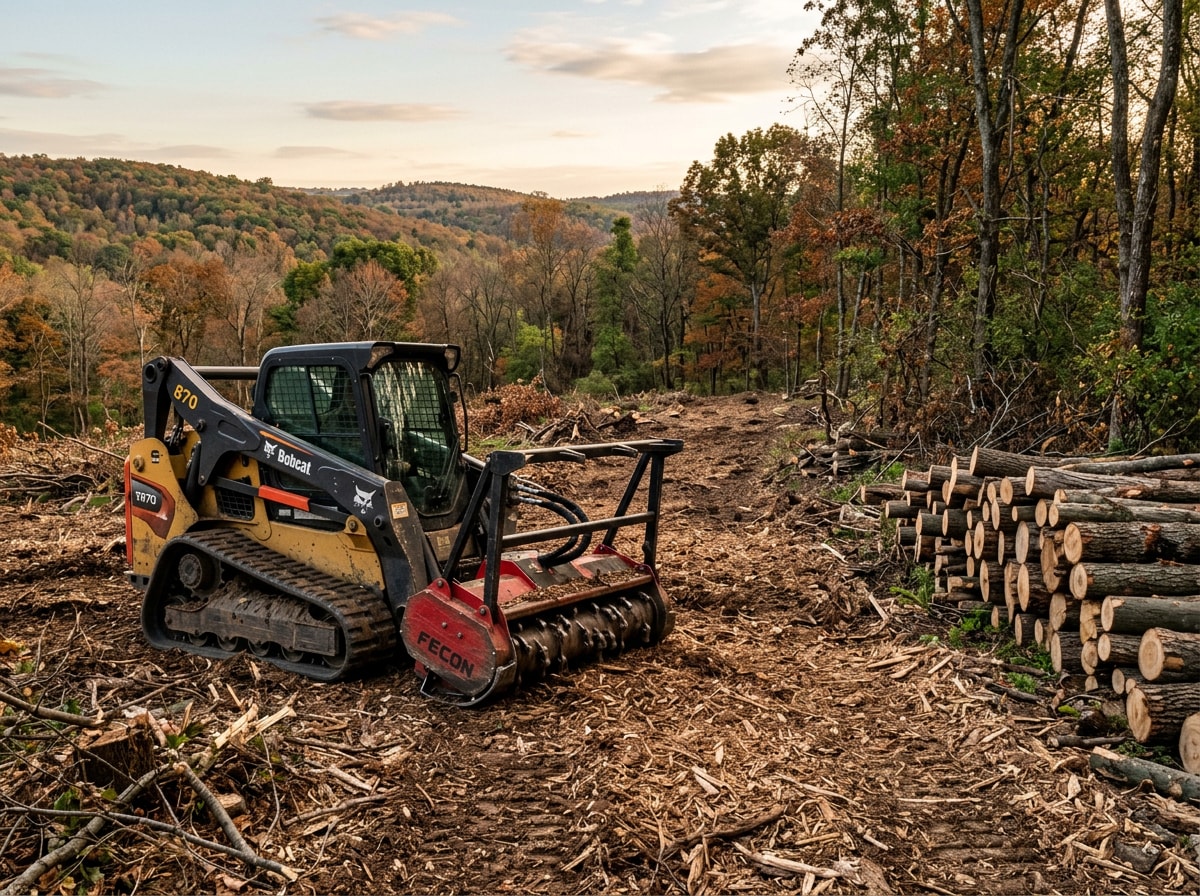
How Much Does Civil Construction Cost in Washington County, PA in 2026?
Pricing depends on soil, depth, and hauling distance more than almost anything else. Market rates for mass excavation run $8 to $25 per cubic yard of material removed, depending on material type, haul distance, and dump costs , and a machine and operator typically bill $150 to $350 an hour or $800 to $2,000 a day . For context, a 2,000-square-foot basement dig, roughly 600 to 750 cubic yards at 8 to 9 feet, runs $3,500 to $15,000 in decent soil , and utility trenching prices out at $10 to $30 per linear foot for typical depths .
| Work type | Typical 2026 range |
|---|---|
| Mass excavation (per cubic yard) | $8 – $25 |
| Equipment + operator (per hour) | $150 – $350 |
| Basement excavation (2,000 sq ft home) | $3,500 – $15,000 |
| Utility trenching (per linear foot) | $10 – $30 |
Rock, high water tables, and tight access all push these numbers toward the higher end. A written scope that breaks out excavation, utilities, and drainage separately is the best way to see where a quote actually lands.
How to Choose a Civil Contractor in Washington County, PA
Before signing anything:
- Confirm licensing and insurance, and ask to see the certificate directly.
- Ask about recent jobs in similar terrain, not just a general portfolio.
- Request references from nearby projects completed in the last year or two.
- Insist on a written scope of work that separates excavation, utilities, and drainage.
- Check whether they own their equipment or sub it out; owned equipment usually means tighter scheduling.
- Ask directly how they handle permitting and any township-specific review steps.
A contractor who answers those questions clearly, without hedging, is usually the one worth hiring. Get a free estimate from our team before you commit to a scope, and we'll walk through what your specific site needs.
If you're also planning the build itself, our guide to timber frame home builders in Washington County, PA covers how site work and framing schedules typically line up.
Who Wrote This Guide
This guide was put together by the site development team at Adirondack Land Management, a land clearing, excavation, and drainage contractor working across Washington County and the surrounding region. The terrain notes and cost ranges above are drawn from active fieldwork on local grading and utility jobs, not just desk research. Questions about a specific property? Contact us directly.
FAQ
What is the difference between a civil contractor and a general contractor?
A civil contractor handles site work and below-grade construction: grading, utilities, and drainage. A general contractor builds the structure above ground. Larger projects typically use both, with civil work scheduled first.
What does a civil contractor do?
Civil contractors prepare land for construction through excavation, grading, site preparation, and sometimes demolition. They also install underground utilities like water, sewer, gas, and electrical lines before any above-ground building starts.
Do I need a permit for excavation or site work in Pennsylvania?
Usually, yes. The Uniform Construction Code requires property owners to obtain a construction or building permit before starting any work , though enforcement and specific requirements vary by township within Washington County. Check with the local building department before digging or grading.
How much does site work or excavation cost in Washington County, PA?
Most residential grading or small excavation jobs run a few thousand dollars, while basement digs, rock removal, or utility installation can push costs into the tens of thousands. Soil type, depth, and haul distance are the biggest variables.
Does Washington County review grading projects for mine subsidence or flooding risk?
For larger subdivisions and land development plans, yes. The county's Planning Commission reviews applications for landslides, wetlands, flooding, mine subsidence, and Natural Heritage Areas as part of its environmental assessment. Smaller residential projects usually don't trigger this review, but it's worth asking about on any multi-lot or commercial site.
How deep can a trench be before special safety rules apply?
Protective systems are required in any trench five feet or deeper where workers will enter , under federal excavation safety standards. Shallower trenches still need safe access and proper spoil placement, but the five-foot mark is where shoring, sloping, or shielding becomes mandatory.